




A theory based on a diversity of approaches
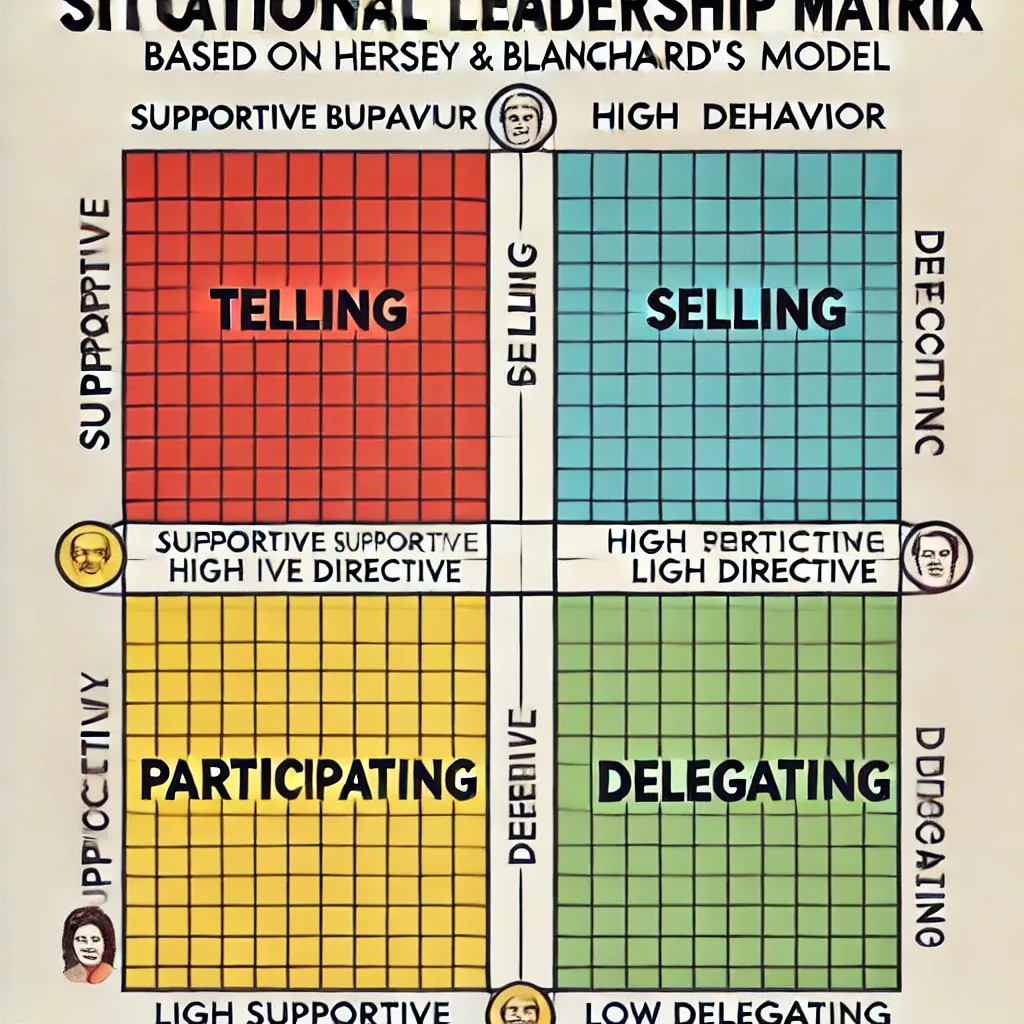
Developed by Paul Hersey and Ken Blanchard in the late 1960s, the theory holds that leaders need to adjust their style based on the development levels of their team members. Instead of a one-size-fits-all approach, leaders assess the competence and commitment of their followers to determine the most effective leadership style.
A model that inspires training around the world
The collaboration between Hersey and Blanchard produced a theory that has become a cornerstone of management training programmes worldwide. The model highlights just how situational leadership really is, and the essential role context plays in decision-making. By adapting their style to fit the moment, leaders can motivate and guide employees far more effectively than with a single, unchanging approach.
What are the benefits of situational leadership in Management training?
In our management training, we build leadership capability by using situational leadership to help leaders adapt their style to what the team actually needs. This flexibility improves decision-making, sharpens communication, and supports team development — leading to better performance overall.
By teaching managers to read the situation and adjust their approach, situational leadership boosts employee engagement, builds trust, and encourages better problem-solving — which in turn supports both productivity and talent retention.
Development Levels of Followers
A critical aspect of the Hersey and Blanchard theory is the evaluation of the development levels of followers. This evaluation helps leaders determine which leadership style to employ. We also provide our definition of Leadership, for clearer understanding. The development levels are categorized as follows:
- D1 – Low Competence, High Commitment: These followers are enthusiastic but lack the necessary skills. They require a directing approach to gain the competence needed for their tasks.
- D2 – Some Competence, Low Commitment: These followers have acquired some skills but lack motivation. A coaching approach is needed to build their confidence and commitment.
- D3 – High Competence, Variable Commitment: These followers possess the skills but may waver in their motivation. A supporting approach helps them stay engaged and motivated.
- D4 – High Competence, High Commitment: These are the ideal followers who are both skilled and motivated. They benefit most from a delegating approach, where they are given autonomy over their tasks.
Practical Applications of the Hersey and Blanchard Model
The practical applications of the Hersey and Blanchard theory extend well beyond the corporate world, across a wide range of industries and organisational structures. Whether in a business, an educational institution, or a non-profit, the principles of situational leadership hold up remarkably well.

Corporate Environments
In corporate settings, leaders often face diverse teams with varying skill sets and levels of commitment. By applying the Blanchard Situational Leadership Model, leaders can more effectively manage their employees. For instance, in a project-driven environment, a leader might use a directing style for new hires (D1) and a delegating style for senior team members (D4). This adaptability ensures that each follower receives the appropriate level of guidance and support.
Educational Institutions
Educators and administrative leaders can also benefit from this leadership theory. Teachers, for example, can use a coaching style for students who understand the material but lack confidence (D2). Conversely, for students who are highly competent and committed (D4), a more delegating approach can foster independence and critical thinking skills.
Non-Profit Organizations
In non-profit organizations, where volunteers often come with different backgrounds and motivations, the Hersey and Blanchard theory can be particularly useful. Leaders can assess the development levels of their volunteers and adapt their leadership styles to ensure high engagement and productivity. For example, a supporting style might work best for seasoned volunteers who are knowledgeable but need occasional encouragement.

FAQ
What are the key components of the Hersey and Blanchard theory?
The key components of the Hersey and Blanchard theory are four primary leadership styles: Telling (directing), Selling (coaching), Participating (supporting), and Delegating. Each style corresponds to a different level of follower readiness, assessed on the basis of their competence and their commitment to the task at hand.
How does the Hersey and Blanchard theory define follower readiness?
Follower readiness in the Hersey and Blanchard theory is defined by two main factors: competence and commitment. Competence refers to the follower's ability to perform a task, while commitment refers to their willingness and confidence to complete it. Based on these factors, followers can be categorized into four levels, which help determine the appropriate leadership style.
Can the Hersey and Blanchard theory be applied to all types of organizations?
Yes, the Hersey and Blanchard leadership theory can be applied to a wide range of organizations, regardless of industry or size. The adaptability of the situational leadership model makes it suitable for various contexts where leaders need to adjust their leadership style based on the readiness level of their followers. This flexibility allows for effective decision-making and leadership in different organizational environments. By understanding the different leadership styles and the dynamics between leaders and their team members, organizations can foster development and enhance the overall effectiveness of their leadership approach.
What are the benefits of using the Hersey and Blanchard theory in leadership?
Using the Hersey and Blanchard leadership theory offers several benefits. It promotes a flexible approach, allowing leaders to adapt their leadership style to the needs of their followers, which can significantly enhance team performance and organizational development. The situational leadership model emphasizes the importance of follower readiness, guiding leaders to select the most effective leadership styles based on task requirements and employee readiness. Additionally, it helps in building stronger leader-follower relationships by addressing the specific requirements of each team member, thus leading to higher motivation and productivity within work environments. As a result, effective leadership can be achieved over the long term by utilizing the insights gained from studying various leadership styles, including participating and delegating leadership styles, as proposed by Paul Hersey and Ken Blanchard.
This article was written by Marc Prager.