



How does equine coaching help to build team cohesion?
Equine coaching involves working with horses to strengthen team dynamics. Horses are highly sensitive to human emotion and behaviour, acting as mirrors that reflect a team's real level of communication and trust — often more accurately than the team would describe itself. Through guided exercises, team members learn to build stronger connections, sharpen their non-verbal communication, and develop genuine trust, creating a more cohesive and collaborative environment.
What activities are involved in equine coaching for teams?
Equine coaching typically involves ground-based exercises, where participants guide and interact with horses without riding them. Activities can include non-verbal communication tasks, problem-solving challenges, and teamwork exercises designed to highlight each team member's strengths and improve the group's collective cooperation, empathy, and mutual understanding — all in a setting where nobody can hide behind a job title.
The benefits of equicoaching for team communication
Equine coaching offers real, distinctive benefits for team communication by building trust, empathy, and non-verbal interaction. Working with horses, teams get real-time feedback on their communication style, which helps them become far more aware of how they actually come across to one another — not just what they intend to say.
In our coaching practice, we use equine coaching alongside other team-building activities to strengthen verbal and non-verbal communication and build team cohesion. Through our equicoaching sessions, participants sharpen their problem-solving skills and, just as importantly, learn to notice the gap between how they think they're communicating and how their behaviour actually reads to the rest of the team.
Understanding the Principles of Equine Coaching
Equine coaching rests on several fundamental principles: experiential learning, emotional intelligence, and effective communication. At its core, the approach encourages participants to take part in hands-on activities with horses, learning by doing rather than by discussing, in order to build personal development and stronger group dynamics — insights that tend to stick far longer than anything covered in a conventional workshop.
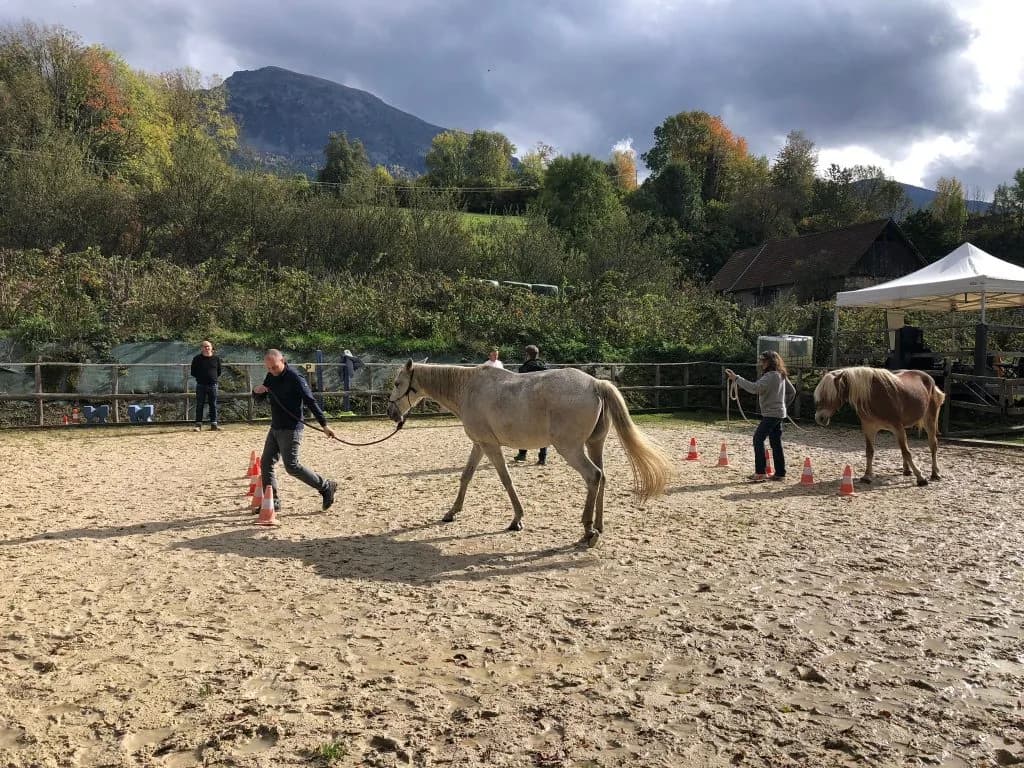
One of the key elements of equine coaching is its emphasis on non-verbal communication. Horses are highly sensitive creatures, and pick up readily on the emotions and intentions of the people around them. As you interact with these animals, you start to understand just how much body language and emotional expression actually communicate. That awareness carries straight back into the workplace, helping team members communicate more effectively and with greater empathy.
Equine coaching also builds trust. Horses need consistent, reliable interaction — they simply won't cooperate with someone who is inconsistent or unpredictable. When participants learn to build trust with a horse, they also learn, almost without noticing, how to extend that same trust to their teammates. This matters in any work environment where collaboration is key: teams that trust one another take more risks, share more ideas, and support each other more readily in reaching shared goals.
The Impact of Emotional Learning in Teams
Emotional learning is a core part of equine coaching, since it directly shapes both team performance and the relationships between colleagues. Engaging with horses lets participants confront their own emotions and see clearly how those feelings shape their interactions with others. This is particularly relevant for building emotional intelligence, a skill that underpins effective teamwork of every kind.
Through a series of guided exercises, participants get the chance to explore their emotional responses in a genuinely safe environment. Working with a horse that seems hesitant or anxious, for example, forces individuals to manage their own emotions and approach the situation calmly rather than reactively — a discipline that mirrors exactly how they may need to handle conflict or difficult moments with colleagues back in the workplace. Many participants say this is the exercise that stays with them longest, precisely because the lesson was felt rather than simply explained.
Other articles on equicoaching
This article was written by Marc Prager.