




What Is the DISC Personality Test?
Developed by William Moulton Marston, a Harvard psychologist, DISC is an assessment tool for understanding distinct personality types. Most people call it a test, but it's really a personality profile — there is no pass, no fail, and no single 'best' profile. DISC evaluates your personality and behaviour, not your skills, knowledge, or intelligence. Two people can hold the same job title and score very differently on DISC, which is exactly what makes the tool useful for building complementary teams.
Why Does the DISC Personality Test Matter?
Whatever your role in the organisation, understanding DISC profiles gives you a genuine edge. Once you understand your own style — and recognise it in colleagues — you communicate with less friction and adapt your approach on the fly. Used well in team building, DISC helps managers anticipate personality clashes before they derail a project, rather than untangling the fallout afterwards.
How Is a Personality Assessment Used in Executive Coaching?
In executive coaching, the DISC personality test lets a coach tailor their approach to a leader's specific behavioural style rather than applying a generic playbook. Understanding a leader's dominant traits helps identify where to build on existing strengths and where blind spots are quietly limiting their effectiveness — for example, a high-Dominance executive who drives results but overlooks team morale, or a high-Steadiness leader who avoids the tough conversations a role demands.
Beyond individual coaching, the DISC Assessment also helps leaders improve team dynamics as a whole. Recognising the mix of personality styles on a team lets a manager adapt communication and delegation on a person-by-person basis — pairing a detail-oriented Compliance profile with a big-picture Influence profile on the same project, for instance — to build a more cohesive and productive working environment.
Can I take the DISC test online?
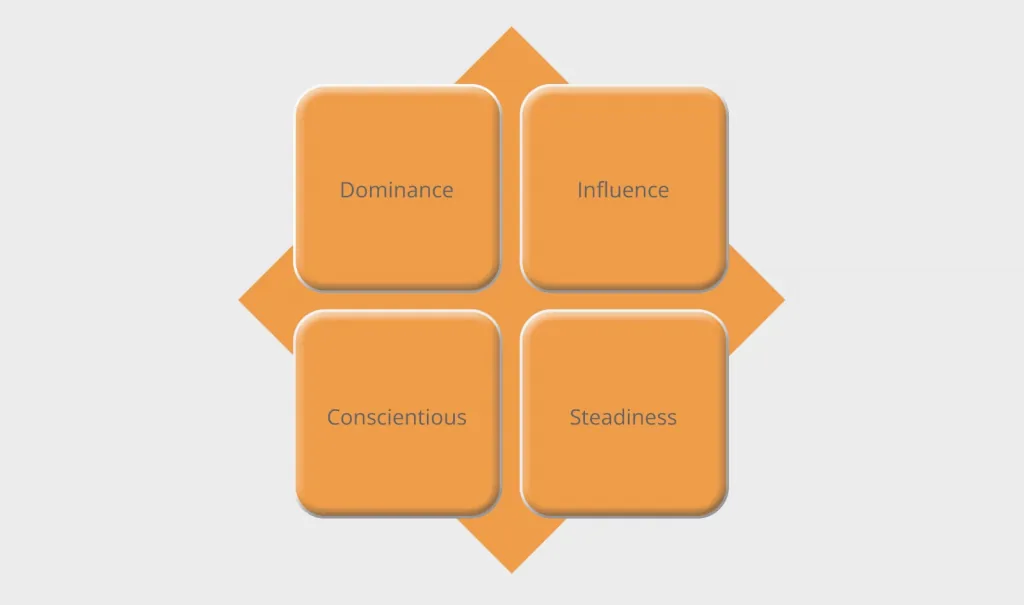
Yes — numerous websites and platforms offer the assessment, free or paid. A full professional questionnaire takes ten to fifteen minutes to complete, while a short version like ours takes only a few. These online tests typically ask a series of forced-choice questions covering the four DISC categories: Dominance, Influence, Steadiness, and Conscientiousness. After completing the online DISC test, you'll receive a report outlining your profile, with insights into your behaviour, communication style, and work preferences. Some versions offer a quick overview; others go much deeper and are better suited to professional development or team building. As with any self-report tool, it pays to choose a reputable source — the quality of the questions directly affects how useful and accurate the results will be.
Whichever version you choose, answer on instinct. The questions are designed to reveal your natural behaviour, not the answer you think is 'right' — and taking the test online, on your own, gives you a private, low-pressure setting in which to be honest rather than perform for an assessor.
What Are the Limitations of the Free DISC Test?
The free option has real limitations. It typically offers a more superficial analysis than paid versions, with broad insights that lack the depth needed for a nuanced read on personality traits — often resulting in generic feedback that misses the complexity of real people. Free reports also tend to cover only your dominant style, without exploring how your profile shifts under pressure or in specific contexts such as conflict or change. Additionally, free DISC test versions may skip detailed reports, tailored action plans, or comparisons against other profiles on your team, which limits the assessment's practical usefulness once you move beyond simple self-awareness.
That doesn't make a free test useless: treat the result as a general guide rather than a precise verdict. Share it with your team and encourage colleagues to take the test too, apply what you learn to the way you communicate and organise your work, and if you find it valuable, move on to a detailed assessment or work with a coach who specialises in DISC.
What Does a Professional DISC Assessment Involve?
A professional assessment follows a few clear stages. You complete a behavioural questionnaire in under fifteen minutes, the publisher's platform analyses your answers, and you receive a detailed report on your profile and management style. You then review the results with a certified practitioner: the debrief usually lasts an hour to an hour and a half, in person or remotely, and can lead on to individual coaching.
I offer a free initial consultation in which I walk you through how I use DISC for leadership development — I have run more than 800 DISC profiles with managers. If you go on to take the full assessment, we work through your detailed profile together and look at how to build on your strengths.
Using DISC to Help Teams Work Better
DISC is valuable for individuals, but its real power often shows at team level. Mapping a team's profiles reveals its collective strengths and blind spots: a group stacked with Dominance and Influence profiles may move fast but overlook risk, while one heavy on Steadiness and Conscientiousness will be thorough but slow to act.
Managers can then delegate more deliberately — detail-heavy work to a Conscientiousness profile, client relations to an Influence profile — and adapt how they communicate: straightforward and results-focused with a Dominance profile, patient and supportive with a Steadiness one. The same awareness helps when planning meetings and presentations, and even when organising the workspace, with quiet areas for those who need focus and collaborative ones for those who thrive on interaction.
What Are the Benefits of DISC Personality Videos?
Personality videos offer real benefits for personal and professional growth. They provide a visual, engaging way to understand the model, which sorts individuals into four broad types: Dominance, Influence, Steadiness, and Conscientiousness. Seeing the styles played out — through short scenarios or real workplace examples — helps people recognise their own traits and those of colleagues far faster than reading a written profile alone, sharpening self-awareness and everyday communication.
In professional settings, DISC videos help teams understand diverse work styles, boosting collaboration and reducing avoidable conflict. They also support leadership development by showing, in practice, how to adapt a management style to different personality types rather than just describing it in theory. Overall, personality videos simplify complex psychological concepts, making them practical for everyday use and strengthening both interpersonal relationships and team dynamics.
Here is one of my short videos on the subject, “DISC Profile: When I'm Sick”:
The Diamond Rule of Communication
We are often taught the golden rule: treat others as you would like to be treated. It has one major flaw — the person in front of you may be wired very differently from you. DISC invites you to apply the diamond rule instead: treat others as they need to be treated.
In practice, that means picking up the clues your counterpart gives you and adjusting your approach accordingly. It takes practice, but it pays off fast: fewer misunderstandings, smoother collaboration and stronger working relationships with every kind of personality on your team.
FAQ
Can I take the DISC test for free?
Yes — including right here: our short version is free and needs no sign-up. Free tests give a useful first impression; a professional assessment goes further, with a detailed report and a debrief.
Will the test put me in a single box?
No. Rather than labelling you as one fixed type, DISC measures the relative strength of all four styles, which is why most people come out with a primary and a secondary style.
Is the DISC test useful in personal relationships?
Absolutely. Understanding the styles of your partner, friends or family helps you communicate with less friction, just as it does with colleagues.
Other Subjects Around DISC Personality
- Understanding DISC: How It Actually Works
- DISC Marston: Decoding the Four Temperaments
- DISC Personality test: the colors red yellow green blue
- DISC Consultant
- DISC personality Tool
- DISC Personality Profile
- DISC Profiles: All Personality Types Explained
- DISC Online Training
- History of DISC
- DISC Personality Types: an Insight into Manager's Style
- DISC Training
- DISC Communication Exercises: Activities For Each Style
This article was written by Marc Prager.